
What to Do If You Can't Join a Toastmasters Club
October 26, 2026

You don't need a club to get better at public speaking. You need reps, feedback, and an audience — and all three can be improvised.
There are plenty of reasons Toastmasters doesn't work out. There's no club within driving distance. The meetings land on the one evening you can't do. You have a newborn. You travel. Or the honest one: the idea of walking into a room of strangers and speaking is exactly the thing you're trying to fix, and you're not there yet.
I'm a Toastmasters fan — I think you should join if you can. But I also won a District Toastmasters International Speech Contest during a stretch when I'd basically stopped attending meetings, because I had a baby at home and no evenings left. Here's what actually worked, roughly in order of how much it gives you for the effort.
1. Eliminate Your Filler Words in Everyday Conversation
Start with this one, because it costs you nothing and works whether or not you ever find an audience.
Benjamin Franklin had a habit of picking the behaviors he wanted to change and reviewing them every night — going through each one and rating how he'd done that day. Over time he moved all of them.
Do the same with filler words. Every "um," "uh," "you know," "like." Notice them during the day, in ordinary conversation, and each evening give yourself an honest score. That's it. After a week or two they start disappearing from your vocabulary, because you can't un-notice them once you've started counting.
Why this is first: cleaning up your fillers puts you ahead of roughly 98% of speakers in any room, and it signals advanced speaker to whatever audience you eventually get. More importantly, you know it about yourself. Walking onstage already knowing you speak better than almost everyone there is a completely different experience from walking on hoping to survive.
Toastmasters has a dedicated role for this — the Ah-Counter, who tracks your fillers and reports back. You can be your own.
2. Talk About Anything, and Watch How You Move
You don't need a topic, an audience, or a reason. Pick something you could talk about forever — your family, your job, something you're obsessed with — stand up, and start speaking.
But here's the part that makes it work. While you talk, pay attention to one thing only: how you move across the room, and what your hands are doing. Where do you walk? When do you stop? What do you do with your hands when you make a point?
Then say the exact same thing again — and this time, move differently. Walk on a different sentence. Use a different gesture to land the same idea. Stay still where you paced before. Try it a third time if you've got the energy.
What you're doing is programming yourself to notice those things while you speak. And here's the beauty of it: once you're genuinely paying attention to where you're standing and what your hands are doing, there isn't much attention left over for fear. It doesn't disappear — it just takes a back seat. Your head is busy with something concrete instead of busy with what everyone thinks of you.
It costs nothing, needs nobody, and you can do it in your living room tonight.
3. Print Out Faces and Practice Looking Them in the Eyes
This is the one that won me a contest.
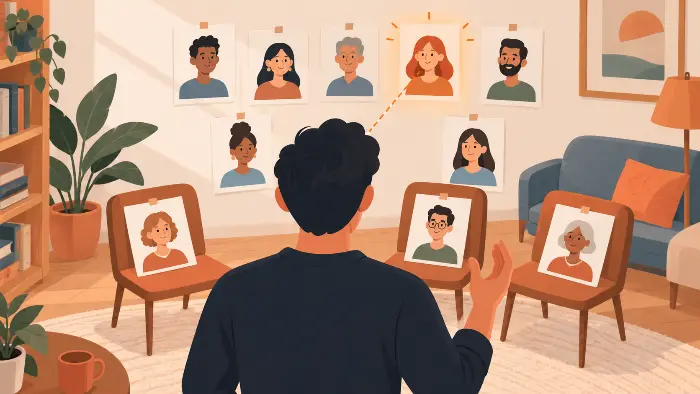
Find five to ten photos of faces online — people looking straight at the camera. Print them. Tape them to a wall, or lay them out on chairs in front of you. Then practice your speech while moving from face to face, holding each one for two or three seconds before moving on.
I never once delivered my contest speech at my club. I had a baby and no time to get to meetings. I did this instead, in my living room, and I won.
Here's why it works so well. When you don't look anyone in the eyes, you're giving one speech to fifty people — which is not a thing humans are built to do. When you hold eye contact with one person for two or three seconds and then move on, you're having fifty conversations with one person, one at a time. And talking to one person is something you already do effortlessly, all day long.
The printed faces build that muscle so that on the day, meeting someone's eyes mid-sentence isn't new.
4. Build Your Own Tiny Club
Fear of public speaking is extremely common — far more common than people admit out loud. Which means there are almost certainly people in your circle who have it too.
So ask around. You don't need five people and a constitution. Two is enough.
Meet weekly or every other week, in person or on a video call, and present something to each other. Keep it genuinely small so it survives contact with real life: if nobody has time to prepare, do two-minute impromptu speeches on topics you're comfortable with. One person throws out a subject, the other starts talking immediately. Then swap, and give each other honest feedback — one thing that worked, one thing to change.
That's most of what a club meeting actually gives you, minus the logistics. And it builds confidence absurdly fast, because you're speaking in front of someone who can see you, which is the part solo practice can't replicate.
If nobody bites, that's fine — it's the one item here that needs another human.
5. A Toastmasters Club in Your Pocket

The gap none of the four fills is feedback. Filler-word tracking has no audience. Printed faces don't tell you how you did. Moving around your living room doesn't score you.
This is the problem I built ToastUp for. It gives you a random Table Topics prompt, records you on camera for two minutes, and scores your speech on 10 metrics — including pace, filler words, pauses, hand gestures and smile — then quotes your own words back to you with specific rewrites.
It's deliberately modeled on Table Topics, because that's the part of a Toastmasters meeting that builds the most confidence per minute: a prompt you didn't expect, two minutes to answer, no script.
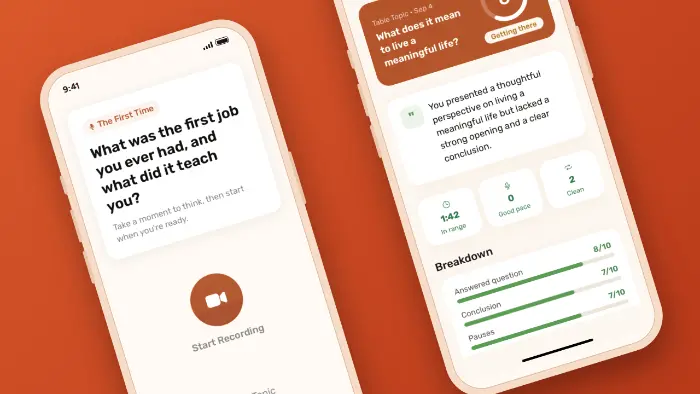
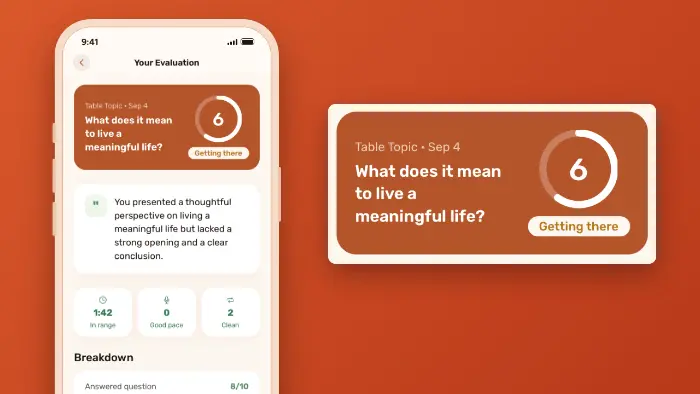
It replaces the Ah-Counter (it counts your fillers), the Timer (it tracks your pace and length), and some of the evaluator (it tells you which specific line fell flat and what to say instead). It does not replace a live audience, and I wouldn't claim otherwise — a room full of people reacting to you is something no app does.
The limits, plainly: it needs camera and microphone access, and you get one free evaluation before it asks you to subscribe. Your video stays on your device — only the audio is sent out, to transcribe and score the speech.
Which One Should You Start With?
| If your blocker is | Start with |
|---|---|
| No club nearby | #1 and #3, then #5 for the daily reps |
| No time for meetings | #1 and #2 — both fit into the gaps of a day |
| Too intimidated to walk in | #1, #2 and #3 first, then revisit a club |
| It's too expensive | #1 to #4 cost nothing |
| You want real feedback | #4 if you can find one person, #5 if you can't |
The honest summary: #1 to #4 are free, take minutes a day, and do more than most people expect. Start there regardless of which reason brought you here.
And if a club does become possible later, go — the point of all this is partly to make that door easier to walk through.