
How to Practice Public Speaking Alone (Without an Audience)
November 2, 2026
Yes, you can practice public speaking alone — and you can build genuine confidence doing it. But not the way you've been told.
The standard advice is to stand in front of a mirror. It turns out that's close to the worst practice you can do. I'll come back to why in a minute.
I won a District Toastmasters International Speech Contest having prepared almost entirely on my own — I had a newborn at the time and couldn't get to my club. So this isn't a theory about solo practice. Here's what actually works when there's nobody in the room.
1. Build Reps With Impromptu Topics
First you need something to talk about. The obvious choice is the speech you actually have to give — and you should rehearse that, but it's a weak practice tool, and here's the trap.
The more times you repeat the same speech, the more your brain goes numb to it. After enough passes you stop paying attention to the words and start reciting them. You're moving your mouth, not speaking. That defeats the whole purpose, and it's why people who rehearse obsessively still freeze when something unexpected happens — they've trained recall, not speaking.
So practice impromptu speaking instead. Ask any AI for a random topic, or pull from a list online. Something like:
If you had to live on an isolated island for a year, who would you bring with you and why?
Then start talking immediately. No planning, no notes. One to two minutes.
It's uncomfortable at first and that's exactly the point — you're practicing the skill of finding words under pressure, which is the skill you actually need on the day.
2. Focus on Exactly One Thing at a Time
This is the technique that builds foundations, and almost nobody does it.
Each time you practice — whether it's your real speech or an impromptu topic — pick one thing to pay attention to, and ignore everything else. Stay on it for a week, then move to the next.
Here are the five, in the order I'd work through them.
Week 1 — Your filler words
Count the ums, uhs, you knows and sos. Don't try to eliminate them yet, just hear them — most people genuinely don't know they say them. Once you can hear one coming, replace it with a closed mouth and a half-second of silence. That silence feels enormous to you and reads as composure to everyone else.
You're improving when: you catch yourself before the filler comes out, not after.
Week 2 — Where you pause
Most nervous speakers never stop talking, because silence feels like failure. It isn't — it's where the audience catches up. Practice pausing deliberately: a full beat after a question, two beats before the line you most want people to remember.
You're improving when: you can hold a silence long enough that it starts to feel uncomfortable, and keep going anyway.
Week 3 — Your pace
Nerves speed you up and you won't feel it happening. The fix is to notice your speed mid-sentence and deliberately slow down, especially in the first two minutes. Record one run and listen back at the start versus the end — almost everyone drifts faster.
You're improving when: you can change your speed on purpose, mid-speech, rather than only discovering it afterwards.
Week 4 — What your hands do
Pick two or three moments in your talk that deserve a gesture and decide what it is. Count on your fingers when you list things, open your palms when you ask something, hold a shape in the air when you describe something. The rest of the time, let them rest — not in pockets, not gripping each other.
You're improving when: a gesture arrives on the right word without you planning it in the moment.
Week 5 — How you move and occupy the space
Pick two or three positions and assign each one a section of your talk. Walk on the transitions, plant your feet when you make the point. Movement that means something looks like confidence; movement that doesn't is pacing, and pacing reads as nerves.
You're improving when: you stop mid-talk and realise you're standing still on purpose.
One week, one focus. It feels slow. It's the opposite: trying to fix everything at once is how people practice for months and improve at nothing.
And there's a second payoff that shows up on the day. Once you've spent weeks deliberately attending to these details, they become your anchor while you speak. Your attention has to be on something, and if it's on am I pausing here, am I moving on this transition, there's much less of it left over for fear. The anxiety drops into the background and stops being the main event.
3. Print Out Faces and Look Them in the Eyes
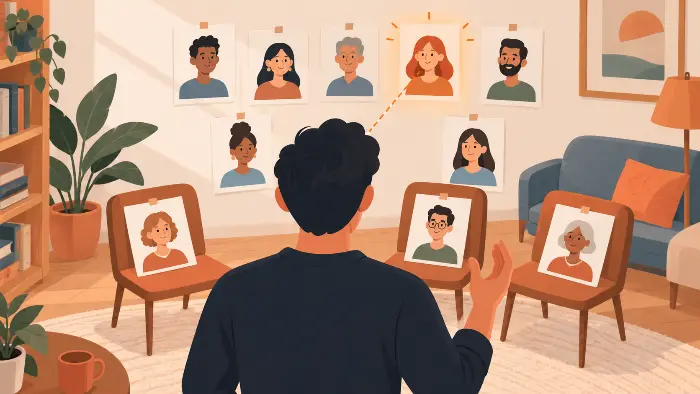
Find five to ten photos of faces online — people looking at the camera. Print them, and tape them to a wall or lay them out on chairs in front of you.
Now practice while moving from one to the next, holding each face for two or three seconds before you shift.
This is the single most effective thing on the list if you have a speech coming up, and the reason is simple arithmetic. When you don't look at anyone, you're giving one speech to fifty people — which nobody is built to do. When you hold eye contact with one person for two or three seconds and move on, you're having fifty conversations with one person. And we all know how to talk to one person; we do it constantly.
The printed faces build that muscle in advance, so meeting someone's eyes mid-sentence isn't a brand-new experience on the day. Do it daily for a week before a talk and the difference is hard to believe.
4. Record Yourself — and Watch It Once
Practicing alone has one blind spot: you have no idea what you look like. Your phone fixes that for free.
Prop it up where the audience would sit, hit record, and do your two minutes. Then — and this is the part people get wrong — watch it exactly once, the whole way through, the way a stranger would. Not in fragments, not on loop, not pausing on the frames you hate.
The first time is genuinely unpleasant. Everyone discovers something: the hands that never move, the sentence that trailed into nothing, the nine ums in ninety seconds. That discomfort is the whole value, and it fades fast — by the third or fourth recording you're not watching a stranger, you're watching someone with a specific list of things to fix.
Pick one thing from what you saw, make it this week's focus from the list above, and delete the video. Keeping them turns a practice tool into a stack of evidence against yourself.
You're improving when: you can watch a recording and describe what to change without flinching at how you look.
5. Practice Daily, Even if It's Only Two Minutes
This is the whole trick, and it's boring, which is why it gets skipped.
When you speak daily, you build the muscle. Frequency beats duration by a long way: two minutes every day does far more than two hours on an occasional Sunday, because what you're training is a nervous system that's stopped treating this as a threat — and that only comes from reps close together.
Two minutes is also short enough that you'll still do it on a bad day. That's not a compromise, it's the design.
So Why Not the Mirror?
Two reasons.
It makes you self-conscious. You end up watching your own face, auditing your expressions, cataloguing what you don't like about how you look. That loop has nothing to do with speaking well, and it tends to leave you feeling worse than when you started.
It rehearses a situation that will never happen. On the day, you will not be looking at yourself. You'll be looking at a room full of other people's faces. Mirror practice trains you for the one scenario you'll never face, which is precisely why printed faces work so much better — same drill, correct target.
That's the difference between the mirror and the camera in point 4. Looking at a recording after the fact is useful feedback. Watching yourself live, while you're still trying to speak, is just interference.

The One Thing Solo Practice Can't Give You
Practicing alone covers reps. What it can't give you is feedback — nobody's in the room to tell you that you said "um" nineteen times, that you were running at 180 words a minute, or that your closing line didn't land.
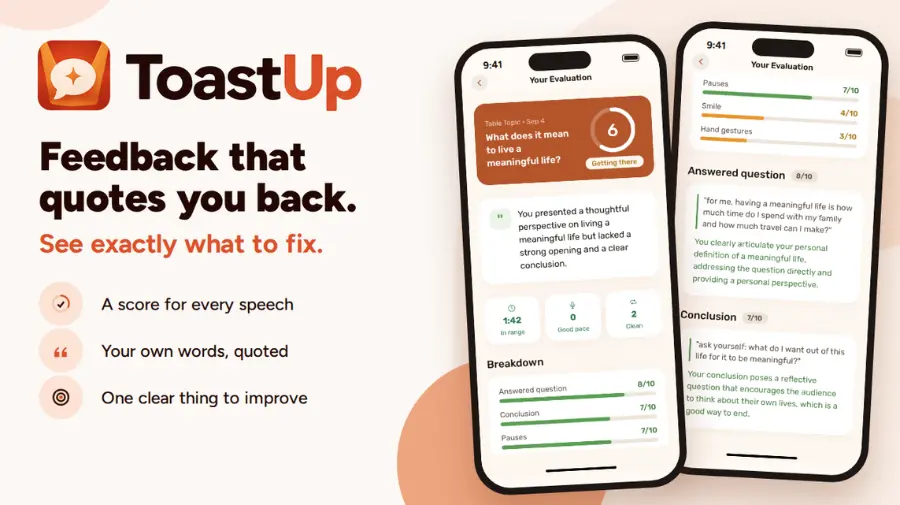
That's the gap I built ToastUp to fill. It gives you a random Table Topics prompt, records you on camera for two minutes, and scores your speech on 10 metrics — including pace, filler words, pauses, hand gestures and smile — then quotes your own words back to you with specific rewrites.
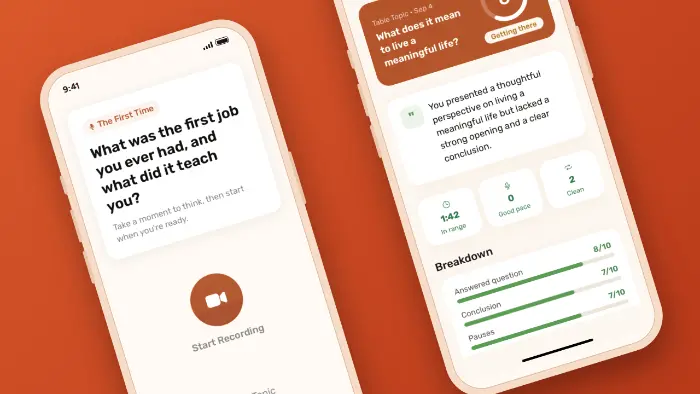
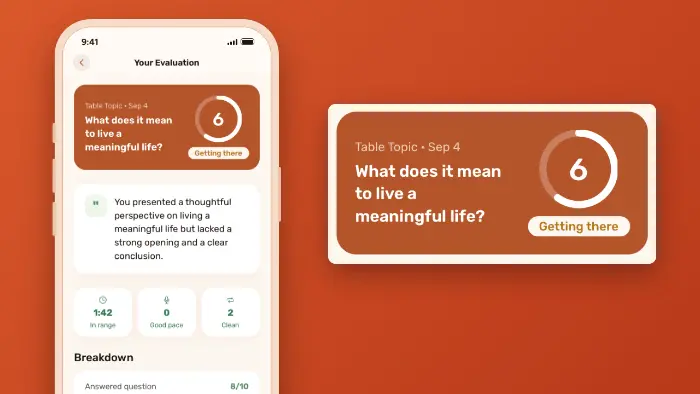
It maps onto this post fairly directly: the prompts handle #1, the per-metric scores let you pick your one focus for the week and watch it actually move (#2), and the two-minute format plus a streak is there to make #4 survivable.
Being straight about the limits: it needs camera and microphone access, and you get one free evaluation before it asks you to subscribe. Your video never leaves your device — only the audio goes out, to transcribe and score the speech.