
Why Am I Afraid of Public Speaking? The 5 Real Reasons
October 12, 2026
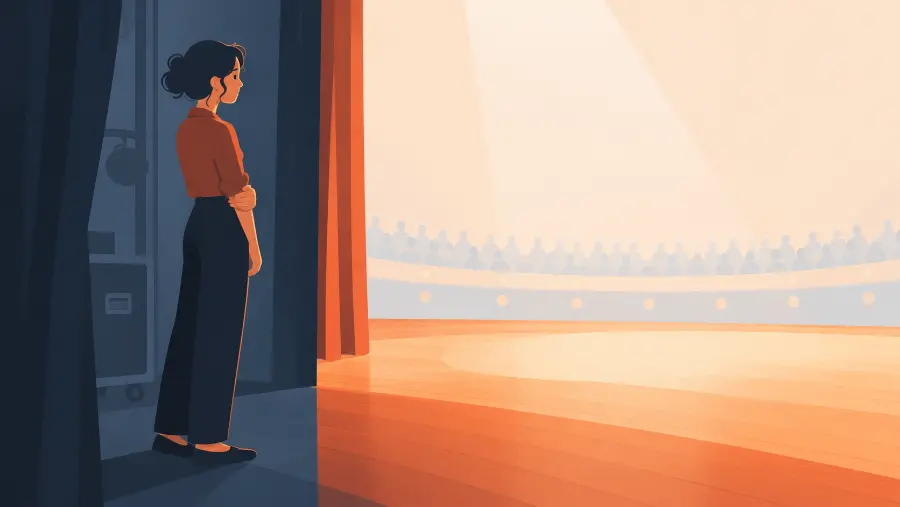
You're not afraid of public speaking. You're afraid of one of five specific things, and they have different fixes.
That distinction matters, because most advice treats the fear as a single problem and hands you the same generic answer — breathe, picture them in their underwear, be yourself. If you don't know what's actually triggering the fear, you can't fix it.
The clinical name for this is glossophobia, and it's one of the most common fears there is. But the label doesn't help you much. What helps is knowing which of these five is yours.
For context: I won a District Toastmasters International Speech Contest. Before that, I was someone who got genuinely stressed preparing an ordinary work presentation. These five are what I had to work through.
1. You Don't Speak in Public Often Enough
This is the big one, and it's the one nobody wants to hear. It's not that you haven't rehearsed your next talk enough — it's that across your whole life, you've barely done this.
Think about it: if you spoke in front of people every single day, how long would it stay scary? A week? Two? By the third week your body stops treating it like a threat. By week ten it's just a thing you do, like driving.
Almost everyone who's terrified of public speaking does it two or three times a year. Of course it's terrifying. You'd be terrified of driving too if you only got behind the wheel at Christmas.
What you're missing is exposure, not talent. And exposure is the one cause on this list you can fix without knowing anything about speaking technique — you just have to do it more often than you currently do.
The fix: get more reps, and make sure they count as reps. Reading your notes sitting at your desk isn't exposure — your body doesn't register it as the real thing. Stand up, say it out loud, use the gestures you'll use, at the pace you'll use. Your body needs to have done the thing before, not just your brain.
2. You're Afraid of Losing Your Train of Thought
The nightmare: you're three minutes in, and your mind goes completely blank.
Here's why it happens. Most people prepare by learning their speech word for word. Memorized text is a chain of arbitrary links — drop one and the whole thing stops, because there's nothing underneath to rebuild it from.
The fix: stop learning the words. Build a mental movie and learn that instead.
Say you're giving a short talk on why someone should adopt a dog, and you have four points: you save a life, you get a hit of joy every time you come home, you walk more, and you sleep safer.
As four bullet points on a card, those are four unrelated things to remember in no particular order — and any one of them can fall out of your head under pressure. So turn them into one scene that runs forward in time:
- You see a puppy in a cage at the shelter, stressed and miserable. You adopt him, and you watch him light up — you saved a life.
- You get home from work and he launches himself at you, out of his mind that you're back — that's the hit of joy, every single day.
- So you clip on the leash and take him out, and you see yourself walking him through the neighbourhood — that's the exercise.
- And at the end of the day he settles in the living room while you sleep, ears up, listening to the house — that's sleeping safer.

Now it's almost impossible to lose a point, because you're not reciting a list, you're replaying a story. You'd notice a missing scene in a film in a way you'd never notice a missing bullet. Each image hands you the next one, so if you do blank, you don't grope around for the words you lost — you just ask yourself what happens next in the movie.
That's the test for a sequence that will hold: every beat should lead to the next one on its own. If one of them doesn't, that's the link you'll drop.
And if you know where you're going, you can always find words to get there, even if they're not the words you planned. Nobody in the audience knows what you planned.
3. You're Taking It Too Seriously
I noticed this preparing presentations at work. I'd get genuinely stressed — and when I looked at why, it wasn't fear of failing. It was that I wanted the presentation to be incredible. I'd set the bar somewhere up near perfect and then panicked about clearing it.
What fixed it was telling myself the truth: most people in that room aren't going to listen that closely. Some are checking email. Most will have forgotten the details by Friday. This is not the most important thing that happens to anyone today.
That sounds defeatist. It isn't. Lowering the stakes lowered the pressure — and my performance got better, not worse. The stress was never helping.
The fix: deflate the moment on purpose. It matters less than you think, and that's good news.
4. You're Afraid of Doing Something Stupid
Stumbling over a word. Losing your place. Saying the wrong name. The fear here isn't really about the mistake — it's about being seen making it.
The fix: walk onstage having already accepted that you're not perfect. Decide in advance that something will probably go slightly wrong, and that it's fine. Once you've given yourself permission to be imperfect, there's nothing left to protect, and that's where the calm comes from. The people who look relaxed up there aren't the ones who never slip. They're the ones who've stopped being afraid of slipping.
5. You're Afraid of the Unknown
You don't know what the room looks like. How close the front row will be. Whether there's a lectern. Whether you'll have to struggle plugging in your HDMI cable in front of everyone. Your brain can't rehearse a scene it's never seen, so it fills the gap with threat.
Before a Toastmasters contest, I went to see the room the night before and walked onto the stage while it was still empty. Then on the day, a couple of speakers before my turn, I had a friend take a photo of the room with the audience in it — so I could see exactly what I'd be walking out to. By the time I went up, nothing about that room was new, and nothing about it was overwhelming.
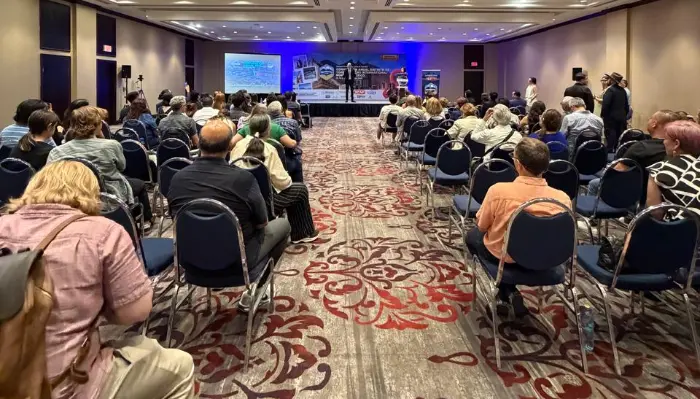
The fix: remove the unknowns you can. Visit the room. Stand where you'll stand. If you can't get there, find out who'll be in the audience, how many, what the setup is — and build the picture deliberately. Every detail you learn in advance is one your brain doesn't have to invent.
So Which One Is Yours?
Usually it's two or three stacked together, with one doing most of the work:
| If this is your fear | Start here |
|---|---|
| "I never do this" | Get more exposure — speak out loud, far more often |
| "I'll go blank" | Learn the logic, not the words |
| "It has to be great" | Deliberately lower the stakes |
| "I'll look stupid" | Accept imperfection before you start |
| "I don't know what it'll be like" | Go see the room |
Notice that four of the five come back to the same place: reps. Lack of exposure is reason one, but exposure also fixes the blanking, takes the weight off the moment, and makes imperfection feel survivable. That's why the single highest-leverage thing you can do is speak out loud more often than you currently do.
If you want the specific techniques, I wrote them up here: the 10 most effective ways to overcome fear of public speaking. And if your problem is that you have nowhere and nobody to practice with, here's how to practice public speaking alone.

I Built a Toastmasters Club for Your Pocket
Toastmasters changed how I speak. Then I had a baby, my evenings disappeared, and I couldn't get to meetings anymore. I still wanted the reps. I just had no club to get them from.
So I built one.
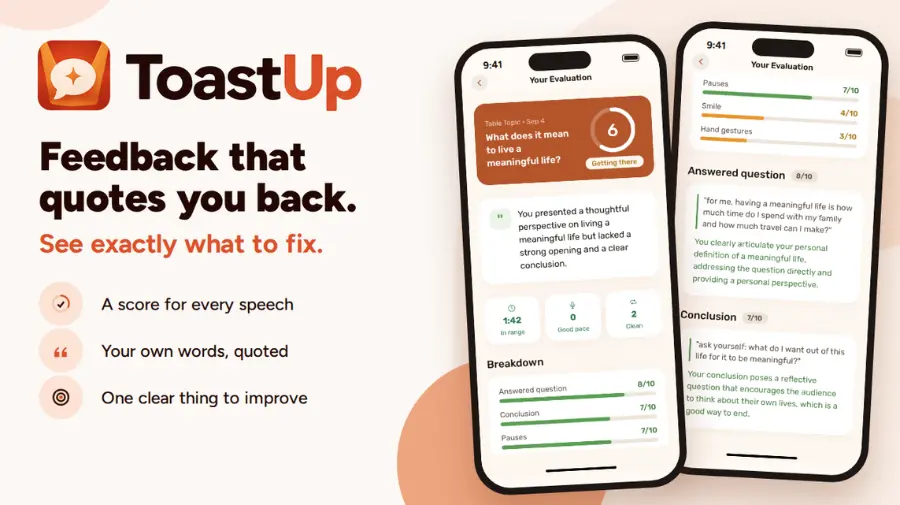
ToastUp works like a meeting you can run any time:
- A random Table Topics prompt — something you didn't see coming
- Two minutes on camera — unscripted, the way the real thing happens
- A score on 10 metrics — pace, filler words, pauses, hand gestures, smile and more
- Your own words, quoted back — the exact lines that worked, and what to say instead
The Ah-Counter, the Timer and the evaluator, without the commute or the calendar invite.
Two minutes a day. That's the whole commitment, and it's deliberately set low enough that you'll still do it on a bad day.
The limits, plainly: it needs camera and microphone access, and you get one free evaluation before it asks you to subscribe. Your video never leaves your device.