
The 10 Most Effective Ways to Overcome Fear of Public Speaking
October 19, 2026
The fear of public speaking — glossophobia — comes down to reps and control. Every technique below either gives you more reps or gives you something concrete to hold onto while you're up there.
Two of them contradict advice you've probably been given your whole life. I'll get to those.
These aren't collected from other people's lists. They're what I used to win a District Toastmasters International Speech Contest, and they're ordered roughly fastest to slowest, so you can start with what helps before your next presentation and work backwards to the foundations.
1. Kill Your Filler Words in Everyday Conversation
Time to feel a difference: one to two weeks
Start noticing every "um," "uh," "you know," "like," "so yeah" — not in presentations, in your ordinary conversations. With friends, on calls, at lunch. Just notice them at first. Then start replacing them with a short silence.
Here's why this is first on the list. Once you've cleaned up your filler words, you are genuinely speaking better than about 98% of people in any room. And you know it. That changes how you walk onstage, because you're no longer hoping to get through it — you're aware the audience is going to notice something good. Confidence that comes from an actual, verifiable skill is completely different from confidence you tried to talk yourself into.
It also has to happen in daily life, not just rehearsal. Fillers are a reflex. You can't suppress a reflex for twenty minutes under pressure; you have to not have it anymore.
2. Start Slow. Much Slower Than Feels Natural
Time to feel a difference: your very next talk
The first few minutes are the hardest part for everyone, including people who do this professionally. You need time to settle in, and the audience needs time to get used to your voice.
So plan to start slowly — genuinely, uncomfortably slowly. Speaking slowly physically lowers your heart rate. Rushing raises it, which makes you rush more, and that loop is what most people experience as panic.
Even better: open with a question. You speak for five seconds, then you get a pause while people think or answer. Ask someone to expand on what they said. You've now been onstage for a minute, you've heard your own voice in the room, and you've barely had to perform yet. It's the smoothest on-ramp there is.
If you can't find a natural question, just go slow. And rehearse it: practice your first two minutes at least twenty times at a deliberately low pace. Then, right before you walk on, tell yourself one thing — anything can happen, but I'm going to start super slowly. That's a promise you can keep no matter what else goes wrong.
3. Look People in the Eyes
Time to feel a difference: your very next talk
The common advice is to look just over the crowd, or at people's foreheads, or at the bridge of their nose, so it feels less intimidating.
In my experience that's exactly backwards.
When you don't look anyone in the eyes, you're having one conversation with a hundred people. That's an impossible thing to do, and your body knows it. When you hold eye contact with one person for two or three seconds, then move to someone else, you're having a hundred conversations with one person — one at a time. And talking to one person is something you already know how to do. You've done it all day, every day, your whole life.
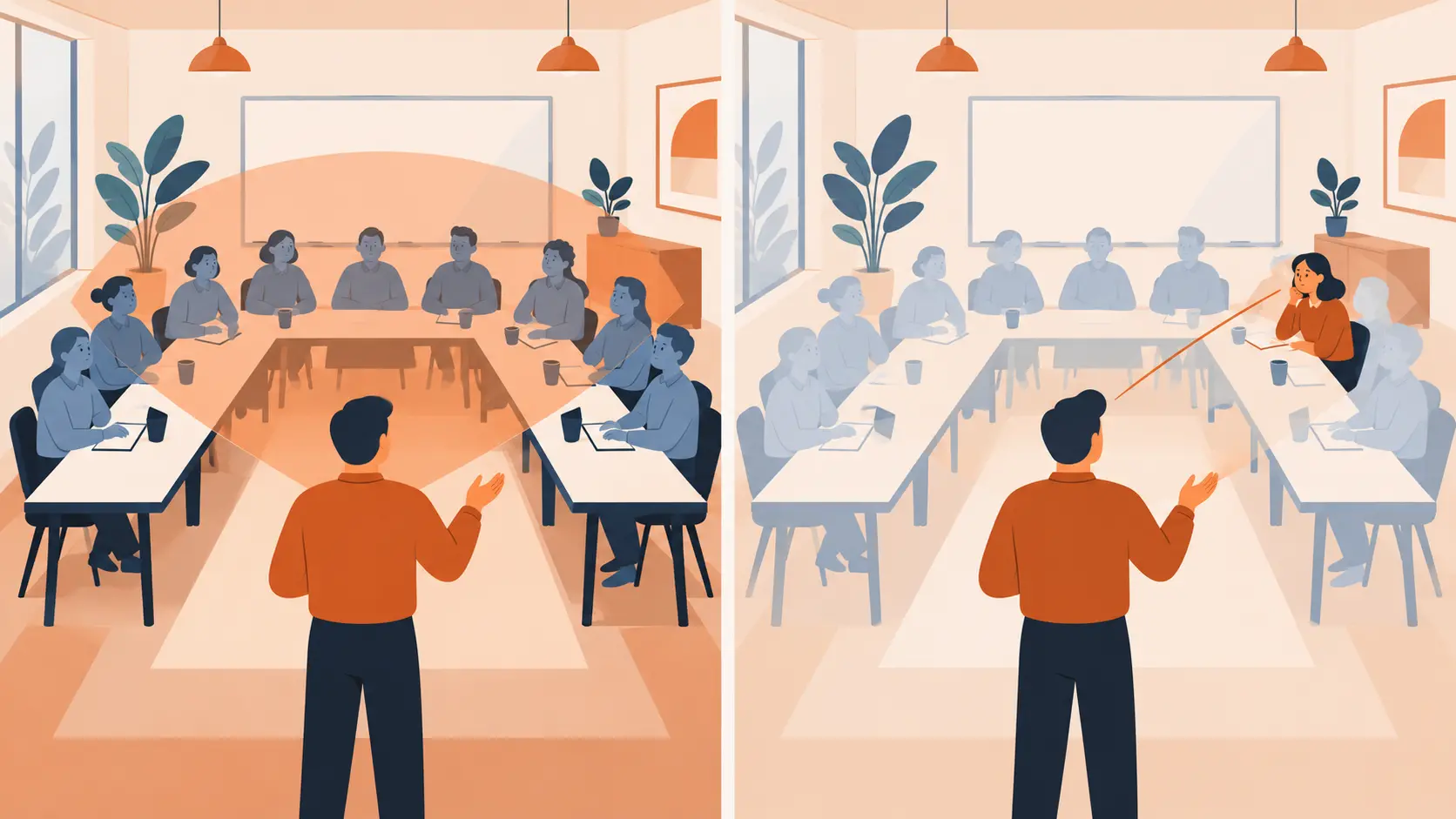
It feels counterintuitive right up until you try it. Then it feels like the room got much smaller.
4. Train Eye Contact With Printed Faces
Time to feel a difference: seven days
This is the drill that makes number 3 possible, and it's the single most useful thing on this list.
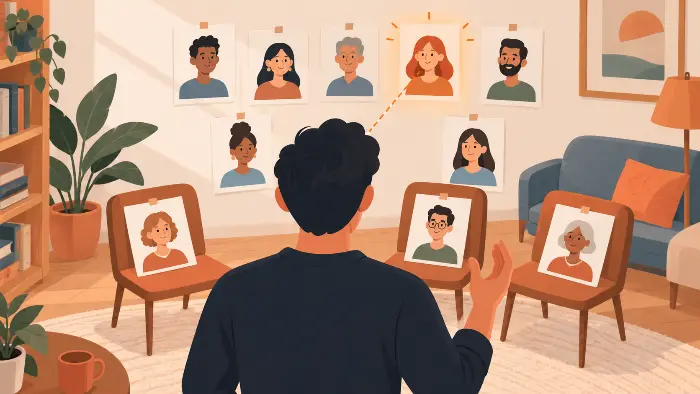
Find ten photos of faces online — just people looking at the camera. Print them. Tape them to a wall, or spread them across chairs laid out in front of you.
Now practice your speaking while moving from one face to the next, holding each for two or three seconds. Do it daily for the week before your talk.
Seven days of this gives you an almost unreasonable amount of confidence on the day, because looking at a human face while continuing to talk is no longer a new experience. You've already done it hundreds of times.
5. Rehearse Your Hands and Your Movement, Not Just Your Words
Time to feel a difference: two to three rehearsals
When you practice, don't only practice the words. Practice where you'll stand, when you'll move, and what your hands do on each point.
Most people stall at the obvious question: where am I supposed to move, and what am I supposed to do with my hands? Keep it simple. Pick two or three positions on the stage and assign each one a section of your talk — walk when you transition, stand still when you make a point. For your hands, choose a gesture for the two or three moments you most want to emphasize. Count on your fingers when you list things. Open your palms when you ask something. That's enough.
The real benefit isn't that it looks better, though it does. It's that it gives you something specific to focus on while you're speaking. Your attention has to be somewhere, and if it's on am I moving on this transition?, there's much less of it available for panic. The fear moves into the background instead of filling the whole screen.
6. Don't Practice in Front of a Mirror
Time to feel a difference: immediately — this is a thing to stop doing
This is the standard advice, and I think it's actively harmful.
Practicing in a mirror makes you self-conscious. You end up watching your own face, judging your own expressions, picking apart how you look — which is a loop that has nothing to do with speaking well and everything to do with feeling worse.
And it rehearses the wrong thing. On the day, you will not be looking at yourself. You'll be looking at a room full of people. Mirror practice trains you for a situation that will never happen, and the real situation will feel more foreign because of it.
Record yourself instead, if you want to see yourself — watch it once, afterwards, like an audience would. And if you want something to look at while you rehearse, use the printed faces from technique 4 — same drill, correct target.
7. Go See the Room
Time to feel a difference: one visit
A lot of the fear is simply not knowing: how big the room is, how close the front row sits, whether there's a lectern, whether you'll be wrestling with a cable in front of everyone.
Before a Toastmasters contest, I went to the venue the night before and walked onto the stage while the room was still empty. Then on the day itself, a couple of speakers before my turn, a friend took a photo of the room with the audience in it, so I could see exactly what I'd be walking out to. By the time I went up, nothing about that room was new to me, and nothing about it felt overwhelming.
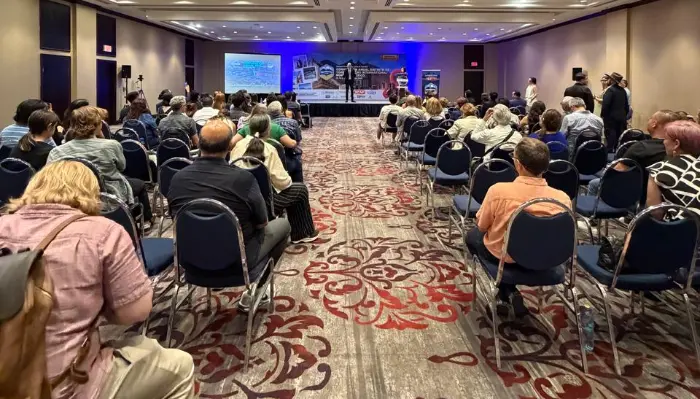
If you can't physically get there, build the picture anyway: how many people, who they are, what the setup is. Every unknown you eliminate is one your brain stops filling in with worst cases.
8. Do Impromptu Speaking Instead of Rehearsing the Same Speech
Time to feel a difference: two to three weeks
Repeating your presentation over and over has a ceiling, and you hit it faster than you'd think. After enough passes your brain goes numb to the material, you stop paying attention to what you're actually saying, and you're just reciting. That's not practicing speaking.
Impromptu speaking is the better drill. Pick a prompt — if you had to live on an isolated island for a year, who would you bring and why? — and start talking immediately for one to two minutes, no preparation.
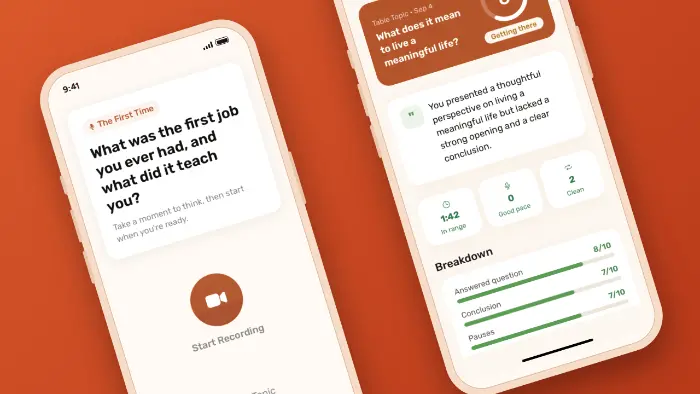
Fair warning: this isn't for everyone, and it's uncomfortable at first. But it does something no amount of rehearsal does. It pulls you slightly out of your own personality and forces you to operate without a script. Without that, you stay stuck in your careful, fearful version of yourself, and you'll walk onstage as that person. With it, you find out you can handle not knowing what comes next.
9. Give Yourself a Reward
Time to feel a difference: immediately, the moment you decide it
Right now there's a date in your calendar and you dread it. Every time it crosses your mind, you feel slightly worse.
So put something you genuinely want on the other side of it.
Maybe it's dinner at your favourite sushi place, ordering your three best dishes. Maybe you go bigger — the week in Cancun you've been putting off. The size doesn't matter as much as the fact that it's real and it's waiting for you on the far side of that date.
Because now something strange happens. You think about the presentation and you don't only feel dread, you also feel the thing you're looking forward to. The date stops being purely a threat. Some part of you starts wanting it to arrive.
One rule, and it's the important one: make it unconditional. Not "if it goes well." Not "if I don't mess up." Regardless of the result. The moment you make the reward depend on your performance, you've just invented another test to fail, and you're back where you started.
Mine was a Christopher Ward C60. Once I spoke at the District contest — whatever the result — I was buying that watch. And I did. The only thing winning changed was that I had it engraved. Same gift either way.
10. Practice Daily, Even if It's Two Minutes
Time to feel a difference: a few weeks, and it compounds from there
This is the foundation under everything else. Frequency beats duration by a wide margin. Two minutes every day will do far more for you than two hours every other Sunday, because what you're building is a body that no longer treats speaking as a threat — and that only comes from repetition close together.
Two minutes is also a bar you can clear on a bad day, which is the entire point.

A Toastmasters Club in Your Pocket
The daily two minutes was the part I kept failing at. No club on a Tuesday night, no audience, no reason to stand up. So I built one.
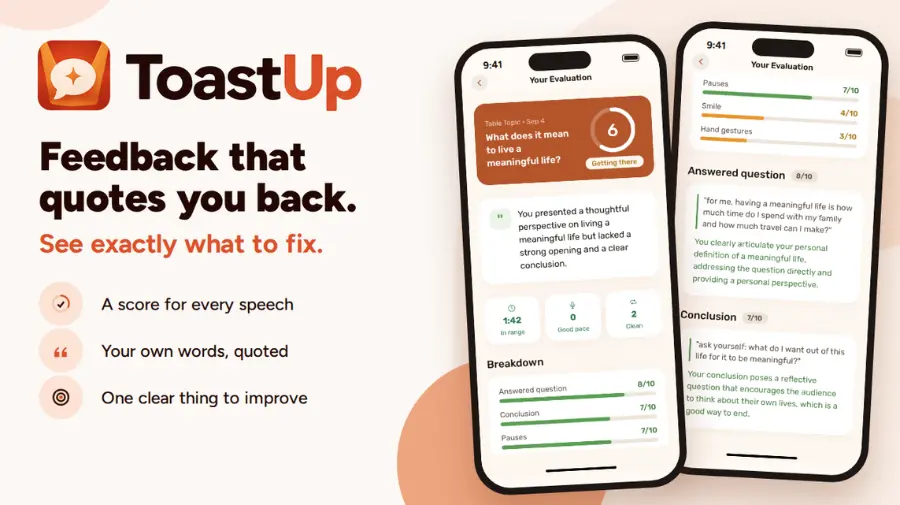
ToastUp works like a meeting you can run any time:
- A random Table Topics prompt — something you didn't see coming
- Two minutes on camera — unscripted, the way the real thing happens
- A score on 10 metrics — pace, filler words, pauses, hand gestures, smile and more
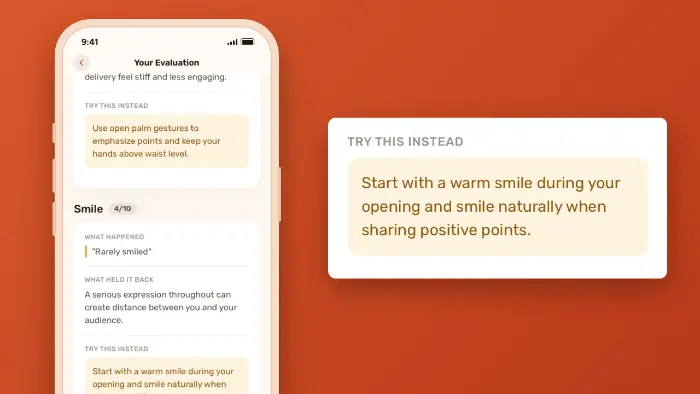
- Your own words, quoted back — the exact lines that worked, and what to say instead
The Ah-Counter, the Timer and the evaluator, without the commute or the calendar invite.
It maps onto the list above on purpose:
- #1, filler words — counted on every rep, so you watch the number come down
- #2, start slow — your words per minute, so you find out whether you really slowed down or only thought you did
- #5, hands and movement — hand gestures are one of the ten scores
- #8, impromptu — every prompt is unscripted by design
- #10, daily reps — a streak to keep, and a two-minute bar you can clear on a bad day
The limits, plainly: it needs camera and microphone access, and you get one free evaluation before it asks you to subscribe. Your video never leaves your device — only the audio is sent out, to transcribe and score the speech.
Where to Go Next
- Not sure which fear is actually yours? Why am I afraid of public speaking: the 5 real reasons
- No club, no audience, no one to practice with? How to practice public speaking alone
- Wondering whether to join a club: Should you join Toastmasters if you're afraid of public speaking?