
7 Techniques to Manage Stress Before a Presentation
November 16, 2026
Presentation anxiety isn't one problem you solve once. It's a series of moments, and each one has a move.
What follows is ordered by the clock, not by importance — from ten days before you speak down to the three minutes after you walk on. That's deliberate. Most advice about nerves is a pile of tips with no timing attached, and timing is most of what makes them work.
I won a District Toastmasters International Speech Contest, and this is the routine I run.
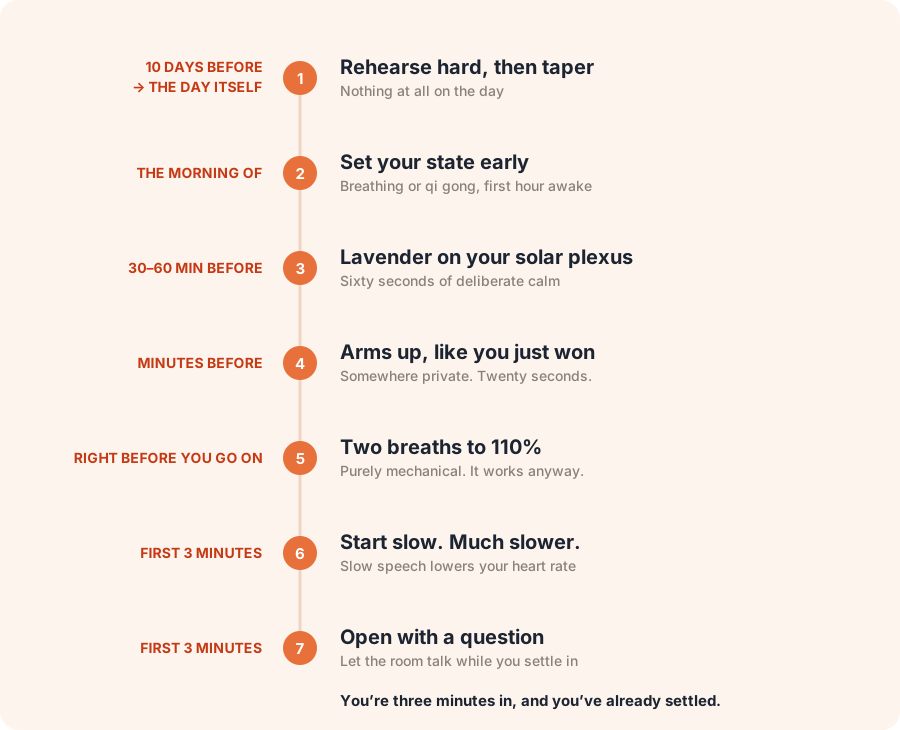
1. Rehearse Hard 10 Days Out — Then Taper to Nothing
When: from ten days before, less and less each day, zero on the day itself
Do your real work early. Ten days out, rehearse properly — out loud, standing, the way you'll actually deliver it.
Then here's the part nobody does: the closer you get, the less you should rehearse. And on the day itself, don't rehearse at all. Not once.
By then you know you know it. That's the whole point. Running it again on the morning of doesn't add anything you don't already have — what it does is tell your brain that this isn't ready yet, that you still need to cram, that something might be missing. You spend the day in a low-grade state of not prepared, which is exactly the feeling you're trying to avoid when you walk out there.
Taper instead. Let the last few days be the days where you're simply someone who already knows their talk.
2. Set Your State in the First Hour You're Awake
When: the morning of
The first hour after you wake up is special. Whatever state you're in during that window tends to become the reference point for your whole day — get wound up early and you spend the rest of the day drifting back to wound up.
So use it. Learn a few qi gong movements, or a breathing routine, and do them in that first hour. Not at lunch, not in the taxi — first thing.
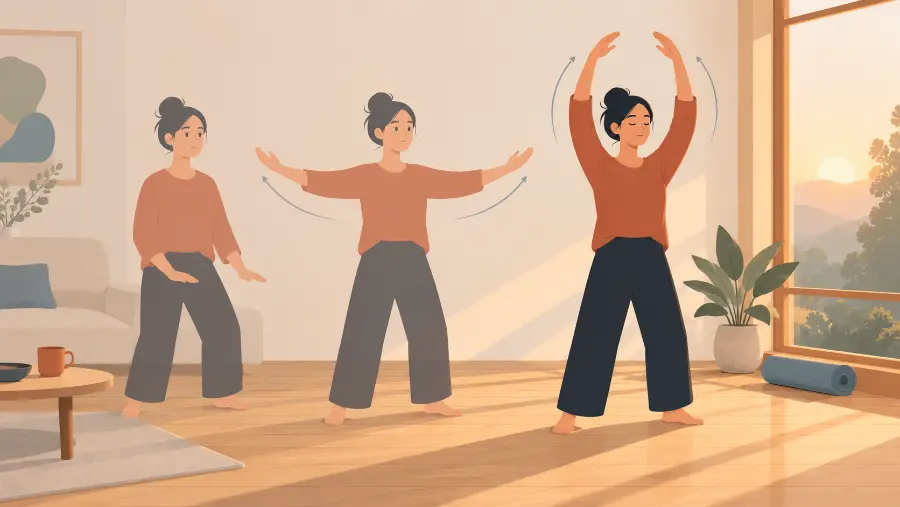
If you feel genuinely relaxed in that window, it's far easier to find your way back to that state at 4pm when you're waiting to be introduced. You're not trying to manufacture calm from nothing at the worst possible moment. You're returning to somewhere you've already been today.
3. Lavender on Your Solar Plexus, 30 to 60 Minutes Before
When: half an hour to an hour before you speak
Put a little lavender essential oil on your fingers and massage your solar plexus — the soft spot just below where your ribs meet.
Lavender relaxes you. It sounds like a small thing and it isn't; this one is powerful, and it has never once failed to make a difference for me. Part of it is the lavender and part of it is that you've given yourself sixty seconds of deliberate physical calm in the middle of the most agitated hour of your day. Either way, it works.
4. Raise Your Arms Like You Just Won the US Open
When: a few minutes before, somewhere private
Go to the bathroom, find a stall or a mirror, and throw both arms up in the air in victory. Not half-heartedly — like you just won the US Open. Like you're a champion.
Here's the logic. Winning makes people raise their arms; that's automatic and universal, nobody teaches you to do it. But it runs the other way too. Putting your body in the posture of someone who just won makes you feel more like someone who just won. The body talks to the brain as much as the brain talks to the body.
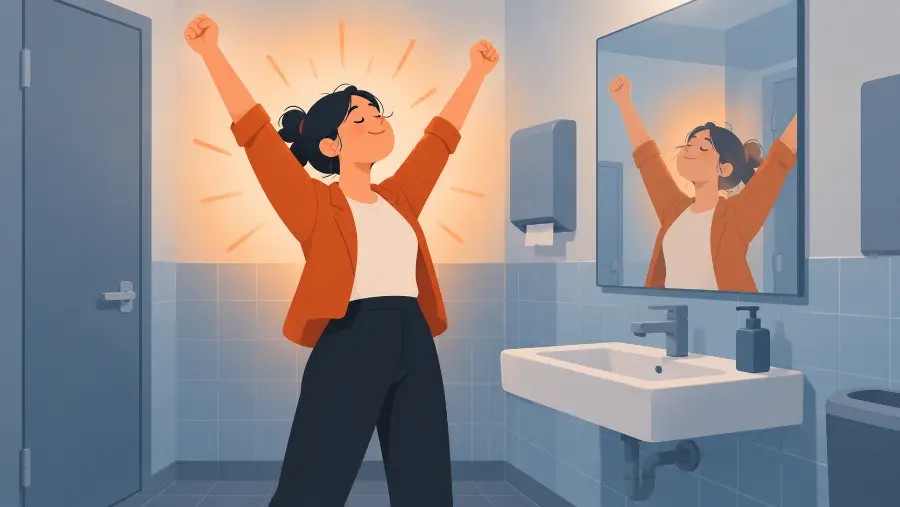
You will feel ridiculous. Do it anyway, for twenty seconds, and notice what you feel like when you drop your arms.
5. Two Breaths to 110%
When: right before you walk on
This one is purely mechanical, which is why I like it. It doesn't require you to believe anything or talk yourself into a mood.
Breathe in until you're at about 95% — the point where you'd normally stop, where your lungs feel basically full. Then keep going. Push to 110%, past where it's comfortable. Hold for a beat. Then breathe out very, very slowly.
Do that twice.
It's a physical override, not a mental one. Your heart rate comes down whether or not you're still nervous, and that's the point — you don't have to feel calm for it to work.
6. Start Slow. Much Slower Than Feels Natural.
When: the first three minutes
The first few minutes are the hardest part for everybody, including people who do this for a living. You need time to settle in, and the room needs time to get used to your voice.
So go slowly at the start. Genuinely, uncomfortably slowly. Speaking slowly lowers your heart rate; rushing raises it, which makes you rush more, and that loop is what most people experience as panic.
It also buys you something you can promise yourself in advance. However the day goes, whatever surprises you, you can decide right now: I'm going to start super slowly. That's a promise you can keep no matter what else happens.
More on why pace is the fastest lever you have →
7. Open With a Question You Prepared Earlier
When: the first three minutes, if you're still uncomfortable
This is the best trick on the list, and it's the one that gets you through the opening without having to perform at all.
Prepare a question in advance and open with it. Something concrete and easy to answer by raising a hand:
"Who here has ever done a parachute jump?"
Hands go up. That's twenty seconds where you're not talking. You look around the room, you count, you say:
"Okay, so about half of you. What was the scariest part?"
Now someone answers. Then you ask another person. Then maybe one more.
And look where you are: you're at the three-minute mark, you've spoken maybe forty seconds, you've heard your own voice in the room, and — more importantly — the audience has stopped being a wall of faces and started being a group of people you've already talked to. Everyone is more comfortable, including you.
The thing that makes this work is that it has to be genuinely unscripted after the first question. You don't know what they'll say. Which is why it's worth being able to speak without a script in the first place.

The Part You Can't Fake on the Day
Six of the seven above are things you do to yourself — the taper, the oil, the arms, the breathing. They work, and you can start using them this week.
But number 7 is different. Taking a question from the room and actually responding to it only works if you're comfortable speaking without a script, and that's not a trick. That's a skill, and the only way to get it is reps.
ToastUp is a Toastmasters club in your pocket. It hands you a random Table Topics prompt, records you on camera for two minutes, and scores your speech on 10 metrics — including pace, filler words, pauses, hand gestures and smile — then quotes your own words back to you with specific rewrites.
It's built for exactly the thing technique 7 asks of you: being handed something you didn't see coming and talking anyway. Do that for two minutes a day and the unscripted part of your presentation stops being the scary part — it becomes the part where you're most comfortable, because it's the only part you practice every day.
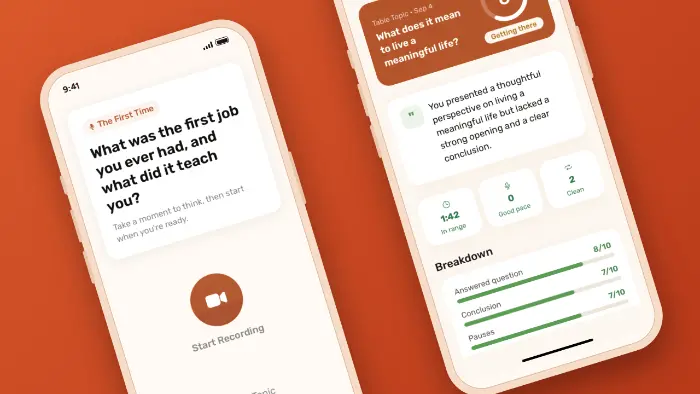
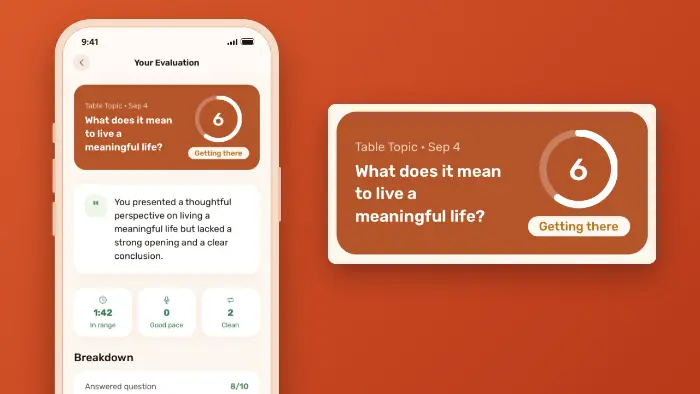
The pace score is the one to watch if you're working on technique 6. It tells you your words per minute, so you find out whether you actually started slowly or just thought you did.
The limits, plainly: it needs camera and microphone access, and you get one free evaluation before it asks you to subscribe. Your video never leaves your device — only the audio is sent out, to transcribe and score the speech.